
Launch offerComplete collection pricing — $39 per volume

Free guide · Positional chess

Chess Strategy for Beginners

A clear introduction to the positional ideas that decide games once the tactics run out: pawn structure, outposts, good and bad bishops, space, prophylaxis, and the accumulation of small advantages. Read it free, then go deeper with the Positional Strategy workbook.

4.8 · 412 reviews

Most beginners lose because they understand chess as a series of attacks and captures, waiting for the opponent to blunder. That works below 1000 rating — and stops working almost immediately above it. Real improvement begins when you learn to evaluate a position that has no forcing moves, form a plan, and improve your position one small step at a time. That is chess strategy, and it is the subject of this guide.

The six concepts below are the foundation of positional play. Each one is a skill you can practice in your own games tonight. They also map directly onto the chapters of Volume 4 — Positional Strategy, our spiral-bound workbook of 200 annotated master games and exercises with solutions.

1. Pawn structure is permanent

Unlike pieces, pawns cannot retreat. Every pawn move commits you for the rest of the game, so the shape of your pawn chain is the single most durable feature of your position. Beginners lose because they push pawns impulsively and create weaknesses — an isolated, doubled, or backward pawn — that an opponent can attack for the next thirty moves. Before you move a pawn, ask: does this weakness still matter in the endgame? If the answer is yes, find another move.

  • Pawns never retreat — treat each pawn move as a lasting decision.
  • Avoid creating isolated, doubled, or backward pawns early.
  • A weak pawn becomes the target your opponent's entire plan is built around.
2. Outposts and square control

An outpost is a square on your opponent's side of the board, protected by one of your pawns, that a piece — usually a knight — can occupy without being driven away. A knight on a strong outpost can be worth more than a rook. The positional skill is recognising the outpost before it is occupied: notice the square, see which pawn would anchor it, and only then bring the piece. This forward thinking is the heart of chess strategy for beginners who want to move past hoping for tactics.

  • An outpost is a protected square the enemy cannot challenge with a pawn.
  • Knights thrive on outposts — a knight there can dominate a rook.
  • Create the outpost first (with a pawn), then occupy it (with the piece).

3. Good bishops and bad bishops

A bishop is 'good' when its own pawns are on squares of the opposite colour, leaving its diagonals open. It is 'bad' when its own pawns block its diagonals. The rule sounds simple, but it decides hundreds of middlegames: a good bishop is an active, long-range piece; a bad bishop is a tall pawn. When you have a bad bishop, the positional plan is either to trade it off or to rearrange your pawns so its diagonals reopen. When you have a good bishop, keep it and widen its reach.

  • A good bishop sees open diagonals; a bad bishop is hemmed in by its own pawns.
  • Fix bad bishops by trading them or by moving the pawns that block them.
  • Good bishops are worth keeping — protect the pawn structure that frees them.

4. Space and restraint

Space is the territory your pawns control beyond the middle of the board. More space means your pieces have room to manoeuvre and your opponent's are cramped. The positional principle is restraint: use your pawns and pieces to deny the opponent the squares they need to free their position, then improve your own pieces slowly while they cannot improve theirs. You are not trying to win immediately — you are trying to reach a position where every one of your moves improves something and every one of theirs loses ground.

  • More space gives your pieces mobility and cramps the opponent's.
  • Restraint: prevent the freeing pawn break before it happens.
  • Improve your pieces one by one while the opponent has no good moves.

5. Prophylaxis — stopping the opponent's plan

Prophylaxis is the art of working out what your opponent wants to do and preventing it. It is the single highest-leverage strategic skill a beginner can learn, because most games below 1600 are lost by the player whose plan gets stopped first. Before every move, ask: if I passed, what is my opponent's best idea? If that idea is dangerous, your move should stop it. Only when the opponent has no active plan should you press your own.

  • Prophylaxis means anticipating and neutralising the opponent's plan.
  • Ask 'what do they want to do?' before asking 'what do I want to do?'.
  • In low-rated games, the first player whose plan gets stopped usually loses.

6. Accumulating small advantages

Modern positional chess, since Steinitz, is built on one idea: the better position is won by accumulating small advantages — a better pawn, a better piece, more space, the bishop pair — until one of them becomes decisive. You do not look for one winning combination. You look for ten tiny improvements, and the game resolves itself. This is the mindset that turns a beginner into a strategic player, and it is the spine of the Positional Strategy workbook.

  • Win by stacking small edges, not by finding one brilliant move.
  • Each advantage — pawn, piece, space, tempo — compounds the others.
  • Steinitz's principle: accumulate advantages until one becomes decisive.

Frequently asked questions

What is chess strategy for beginners?
Chess strategy for beginners is the study of long-term, non-forcing plans — pawn structure, piece placement, space, and prophylaxis — as opposed to short-term calculation of tactics. The two work together: strategy builds the position that makes tactics possible.
Should a beginner learn tactics or strategy first?
Tactics first, because you cannot apply strategy if you drop pieces. But strategy should follow almost immediately: once you stop hanging material, positional understanding is what separates players who plateau from players who keep climbing.
How long does it take to learn positional chess?
The core ideas — weak pawns, outposts, good and bad bishops, space, prophylaxis — can be understood in a few focused sessions. Applying them accurately in your own games takes longer, which is why a structured workbook with annotated master games and exercises accelerates the process.
Which volume covers positional strategy?
Volume 4 — Positional Strategy — covers pawn weaknesses, outposts, good and bad bishops, space, restraint, prophylaxis, and accumulating small advantages, with Steinitz and Lasker games explained in modern language and exercises with solutions.
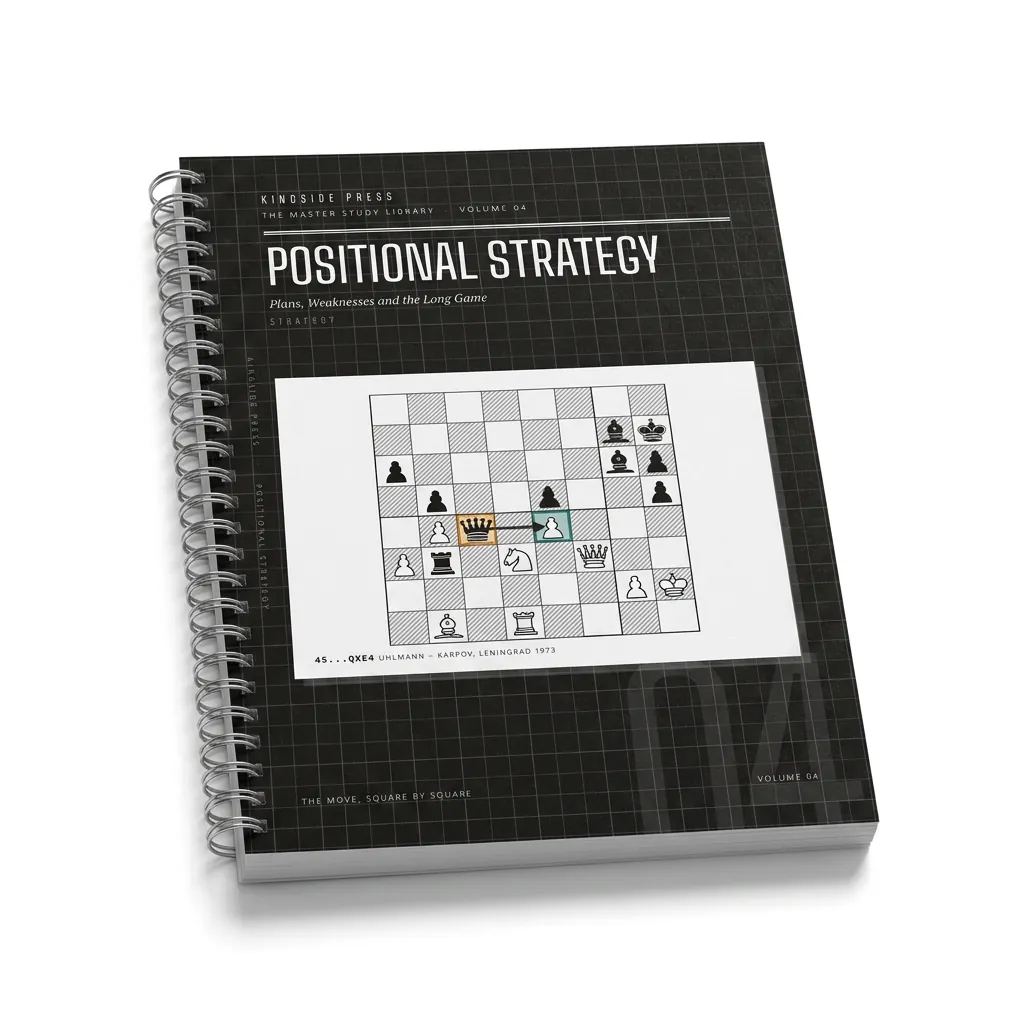
Volume 4: Positional Strategy — spiral-bound chess workbook mockup

Volume 4 · Positional Strategy

Take positional strategy from idea to instinct

Every concept in this guide is taught in depth in Volume 4, with Steinitz and Lasker games explained in modern language and exercises with solutions on a later page so you are forced to calculate.

$39per volume in the set$47 standalone
Get Positional Strategy
  • Instant PDF download
  • Secured by Stripe
Accepted card brands: Visa, Mastercard, American Express, Discover
