Chess notation is the alphabet of chess literature. Every book, every database, every annotated master game and every PDF workbook you will ever study is written in it — including ours. Learning it takes about fifteen minutes and permanently unlocks the entire body of chess knowledge.
This guide covers standard algebraic notation from the ground up: how squares are named, how each piece is written, how captures, checks, castling and promotion are recorded, and how to read a complete game score without getting lost.
1. Every square has a name
The board is a grid of files (columns) labelled a to h from White's left, and ranks (rows) numbered 1 to 8 from White's side. A square is named by its file then its rank: e4, d5, g1. This never changes — e4 is e4 whether you are playing White or Black.
One orientation check before anything else: the bottom-right corner square must be light. If it is dark, the board is turned the wrong way and every coordinate you read will be wrong.
Files are letters a–h, ranks are numbers 1–8.
Squares are written file first: e4, not 4e.
White's home ranks are 1 and 2; Black's are 7 and 8.
2. Piece letters and basic moves
Each piece has a capital letter: K king, Q queen, R rook, B bishop, N knight (N because K is taken). Pawns have no letter at all — a move written as just a square, like e4, is a pawn move.
A move is the piece letter plus the destination square: Nf3 means a knight goes to f3. When two identical pieces could reach the same square, add the file or rank of the one that moves: Nbd2 (the knight from the b-file) or R1e2 (the rook on rank 1).
♜
♞
♝
♛
♚
♝
♞
♜
♟
♟
♟
♟
♟
♟
♟
♟
♙
♘
♙
♙
♙
♙
♙
♙
♙
♖
♘
♗
♕
♔
♗
♖
1.e4 e5 2.Nf3Three moves written and played: 1.e4 (pawn, no letter), 1...e5 (Black's reply), 2.Nf3 (knight to f3, attacking e5).Black to move
K Q R B N — knight is N; pawns have no letter.
Move = piece letter + destination square (Nf3, Bc4, Qd2).
Disambiguate with the file or rank when two pieces can reach the square.
3. Captures, checks, castling and promotion
A capture uses x: Nxe5 means the knight captures on e5. Pawn captures include the pawn's starting file: exd5 means the e-file pawn captures on d5. En passant is written by destination square, optionally with e.p.
A check is +, checkmate is #. Castling kingside is 0-0 and queenside is 0-0-0 (some books use O-O with letters). Promotion is written with an equals sign: e8=Q means the pawn reaches e8 and becomes a queen. Draw offers, results and clock times are recorded separately: 1-0 White won, 0-1 Black won, ½-½ draw.
x = capture, + = check, # = checkmate.
0-0 kingside, 0-0-0 queenside castling.
e8=Q for promotion; 1-0, 0-1 and ½-½ for results.
4. Annotation symbols in books and workbooks
Annotators grade moves with a small set of symbols: ! a strong move, !! brilliant, ? a mistake, ?? a blunder, !? interesting and worth considering, ?! dubious. Positional assessments use ± (White clearly better), ∓ (Black clearly better), = (equal) and ∞ (unclear).
These symbols carry a lot of meaning in very little space, which is why annotated game collections are the densest study material available. When a workbook writes 21.Nxd5!! ±, it is telling you both that the move is spectacular and that the resulting position is winning for White.
= equal, ± White better, ∓ Black better, ∞ unclear.
Symbols are how annotated collections compress an entire verdict into two characters.
5. Reading a full game score and PGN
A game score is numbered by move pair: '1.e4 e5 2.Nf3 Nc6 3.Bb5' means White's first move, Black's reply, and so on. When a text quotes only Black's move it uses three dots: 3...a6.
PGN (Portable Game Notation) is the same thing in a computer file, preceded by tags in square brackets for event, players, date and result. Any PGN can be pasted into a board viewer to replay the game move by move — which is how you should study every annotated game you meet.
The fastest way to make notation automatic is to play through annotated games on a real board, one move at a time. That is exactly how the 200 annotated master games in The Master Study Library are laid out: one diagram per key move, so you never lose your place.
Move numbers count pairs: White's move then Black's.
'3...a6' means the move belongs to Black.
PGN files replay in any viewer; annotated games are the fastest way to internalise notation.
Chess terms used in this guide
Algebraic notation
The modern standard for recording chess moves, naming each square by file letter and rank number.
Disambiguation
Adding the file or rank of the moving piece when two identical pieces could reach the same square, as in Nbd2.
PGN
Portable Game Notation — the plain-text file format used by databases and engines to store complete games.
FEN
Forsyth-Edwards Notation — a single line of text describing one exact position, used to set up puzzles and diagrams.
Frequently asked questions
What does N mean in chess notation?
N is the knight. K is already used for the king, so the knight takes the second letter of its name.
How do you write a pawn move?
With the destination square alone — e4, d5, h6. Pawn captures include the starting file, like exd5.
What do ! and ? mean in chess books?
! marks a strong move and !! a brilliant one; ? marks a mistake and ?? a blunder. !? means interesting and ?! means dubious.
What is the difference between algebraic and descriptive notation?
Algebraic names squares absolutely (e4) and is the modern standard. Descriptive notation, used in older books, names squares relative to each player (P-K4) and is no longer taught.
What is a PGN file?
Portable Game Notation: a plain text file containing the game's moves in algebraic notation plus tags for players, event, date and result. Any chess viewer can replay it.
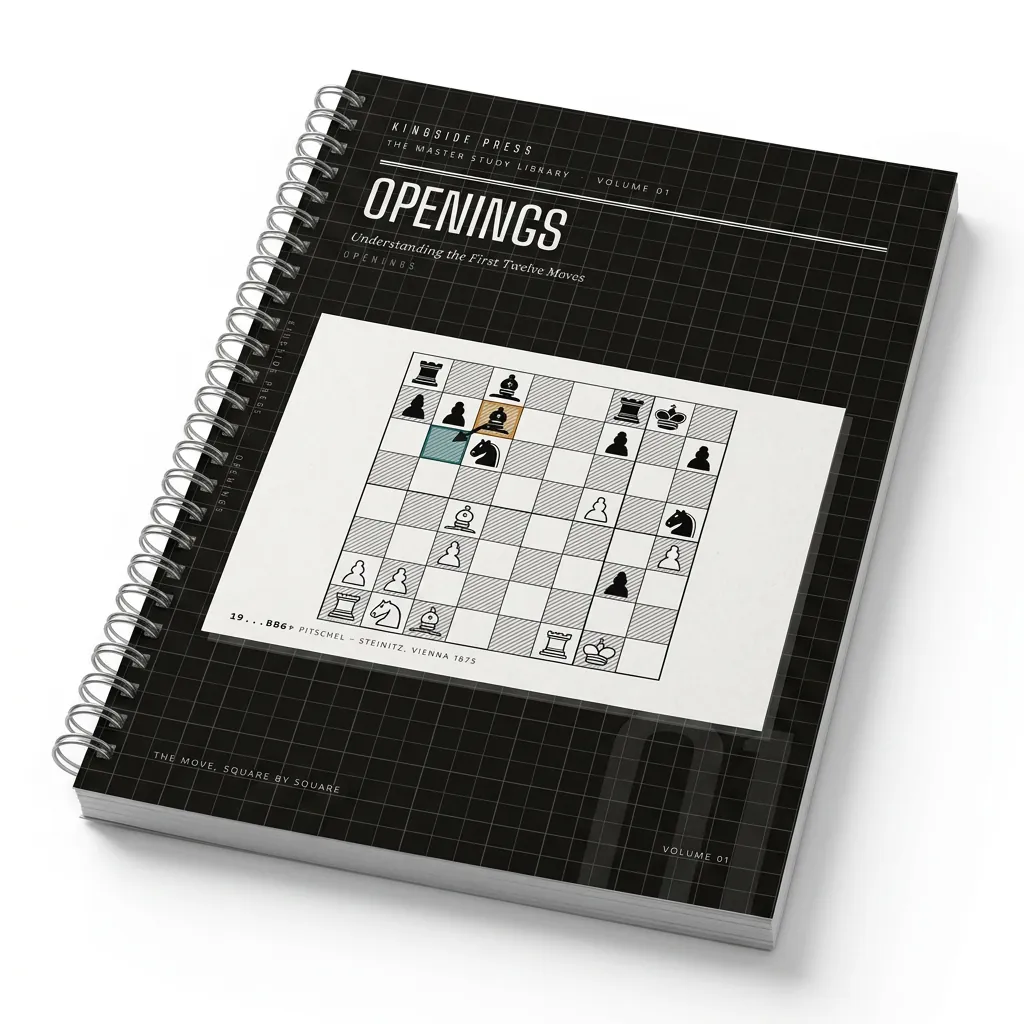
Volume 1 · Openings
Understanding the First Twelve Moves
Development, control of the centre, tempo and king safety — and the real cost of grabbing material too early. You see how a small opening advantage turns into a winning middlegame.