Solving chess puzzles is the highest-return training there is for players under 1500, because the vast majority of games at that level are decided by a single tactic — a hanging piece, a fork, a back-rank collapse. Puzzles train you to see them before your opponent does.
But puzzle practice can also be wasted time. This guide covers what a beginner puzzle actually tests, a solving method that transfers to real games, how many to do per day, and the four habits that turn puzzles into rating points.
1. What every beginner puzzle is really testing
Almost every puzzle below 1200 is one of eight patterns: the fork, the pin, the skewer, the discovered attack, the double check, the removal of the defender, deflection, and the back-rank mate. Once you can name the pattern, the moves usually follow within seconds.
That is why puzzle training works so quickly: you are not getting smarter at calculating, you are building a library of shapes your eye recognises without effort. The same shapes appear thousands of times across your chess life.
♚
♘
♛
♔
Nc5+ forking king and queenThe classic knight fork: one move attacks the king and the queen at once, and the check means the queen cannot be saved.White to move
Eight patterns cover most beginner puzzles.
Naming the pattern is faster than calculating from scratch.
Recognition, not raw calculation, is what you are building.
2. A solving method that transfers to real games
Work in this order every time. One: list every checking move you have. Two: list every capture. Three: list every move that creates a serious threat. Checks, captures, threats — the forcing moves, in that order, because a forcing move limits the opponent's replies and makes the position calculable.
Then, before you play, look at the opponent's answer. The single most common puzzle failure is finding a beautiful first move and missing a defensive resource on move two. Say the opponent's best reply out loud before committing.
Never move the pieces to find the answer, and never guess to see if the puzzle turns green. Both habits teach you a behaviour you cannot use in a real game, where nothing tells you whether you were right.
Checks, captures, threats — always in that order.
Calculate the opponent's best reply before playing your move.
No guessing and no moving the pieces — solve it in your head.
3. How many puzzles per day, and at what difficulty
Twenty to thirty focused puzzles a day beats two hundred rushed ones. Difficulty should sit where you solve roughly 70–80% correctly: too easy and you are only recalling, too hard and you are guessing. If you are getting 95% right, raise the level.
Split your time: about 70% pattern-recognition puzzles at your level, and 30% deliberately harder positions where you sit for five to ten minutes calculating properly. The slow ones build calculation depth; the fast ones build vision.
20–30 focused puzzles a day, not hundreds of rushed ones.
Aim for a 70–80% solve rate — that is the learning zone.
Mix quick recognition sets with a few long, hard calculations.
4. Review is where the learning actually happens
A puzzle you failed is worth ten you solved. When you get one wrong, do not click past it: work out which pattern you missed, name it, and write it down. A one-line note — 'missed a deflection: the defender was overloaded' — is what turns a mistake into a pattern.
Every two weeks, re-solve the ones you failed. If you fail the same shape twice, that is a specific gap you can close with targeted study rather than more random puzzles.
Name the pattern you missed and note it in one line.
Re-solve failed puzzles a fortnight later.
Repeated failures of the same shape point to a specific gap.
5. Why paper puzzles beat apps for deep practice
Apps optimise for speed and dopamine: a timer runs, a wrong move flashes red, and you learn to move fast rather than to be sure. On paper there is no feedback until you turn the page, which forces the exact discipline a real game demands — decide, commit, then check.
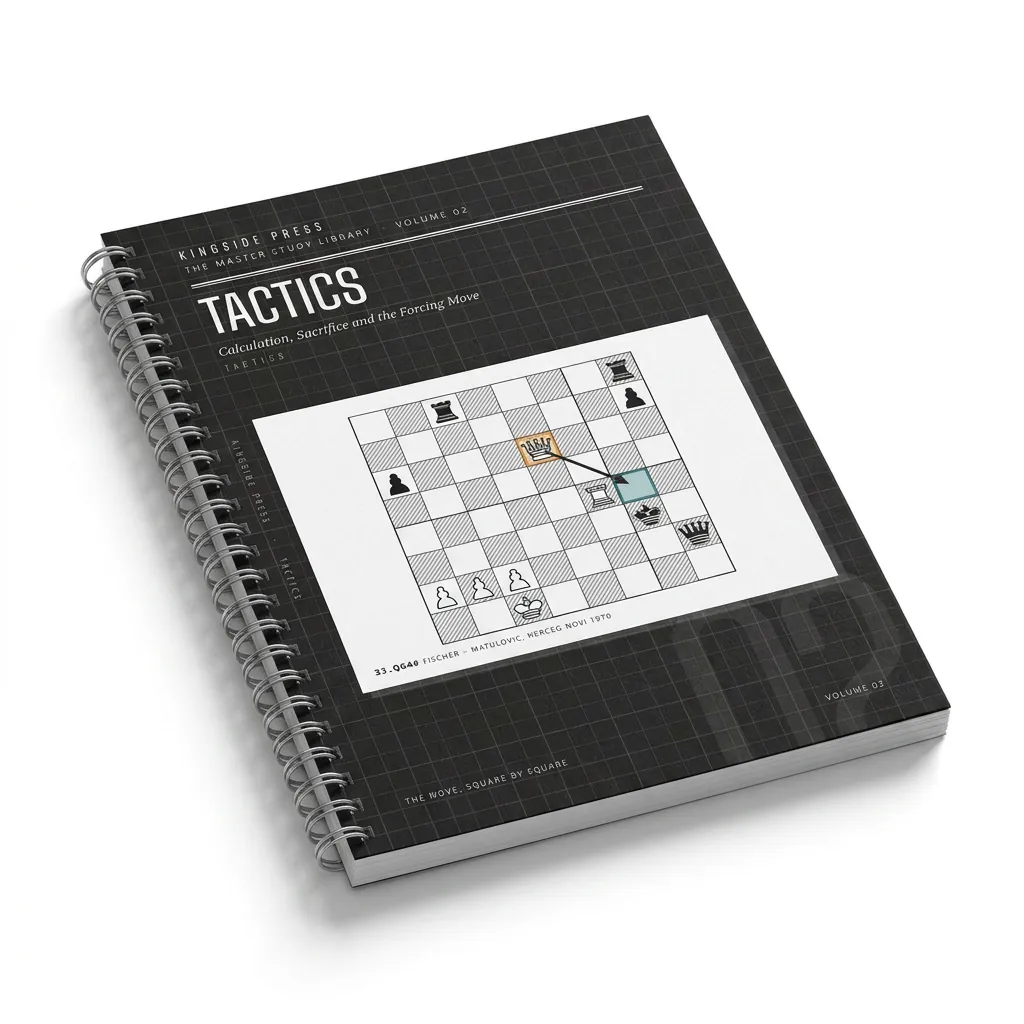
That is the format of the exercises in The Master Study Library: positions taken from real master games, printed with one board per move, and solutions placed on a later page so you cannot peek by accident. Print the pages, solve with a pen, and the habit carries directly into your tournament games.
No instant feedback means no guessing — decide, then verify.
Print-friendly pages let you solve away from a screen.
Puzzles drawn from real games teach patterns in the contexts they occur.
Chess terms used in this guide
Fork
One piece attacking two or more enemy pieces at once — the most common tactic in beginner games.
Deflection
Forcing a defending piece away from the square or piece it protects.
Removal of the defender
Capturing or driving off the piece that holds a key square, so a second tactic becomes possible.
Forcing move
A check, capture or serious threat that severely limits the opponent's replies, making calculation reliable.
Frequently asked questions
How many chess puzzles should a beginner do per day?
Twenty to thirty solved carefully, with review of the ones you miss. Quality of attention matters far more than volume.
Do chess puzzles actually improve your rating?
Yes — below 1500 most games are decided by a single tactic, so pattern recognition from puzzles converts directly into results, provided you review your mistakes.
What tactics should a beginner learn first?
The fork, pin, skewer, discovered attack, double check, removal of the defender, deflection and the back-rank mate. These eight cover most beginner tactics.
Should I solve puzzles fast or slowly?
Both. Use quick sets at your level to build vision, and a few five-to-ten-minute positions to build calculation depth.
Are printed chess puzzles better than apps?
For deep practice, yes: with no instant feedback you must commit to an answer, which is exactly what a real game requires.
Volume 2 · Tactics
Calculation, Sacrifice and the Forcing Move
Seeing forced continuations and trusting them. Double attack, pin, deflection, clearance and quality sacrifices — plus the discipline of calculating a line to the end instead of stopping at the pretty move.