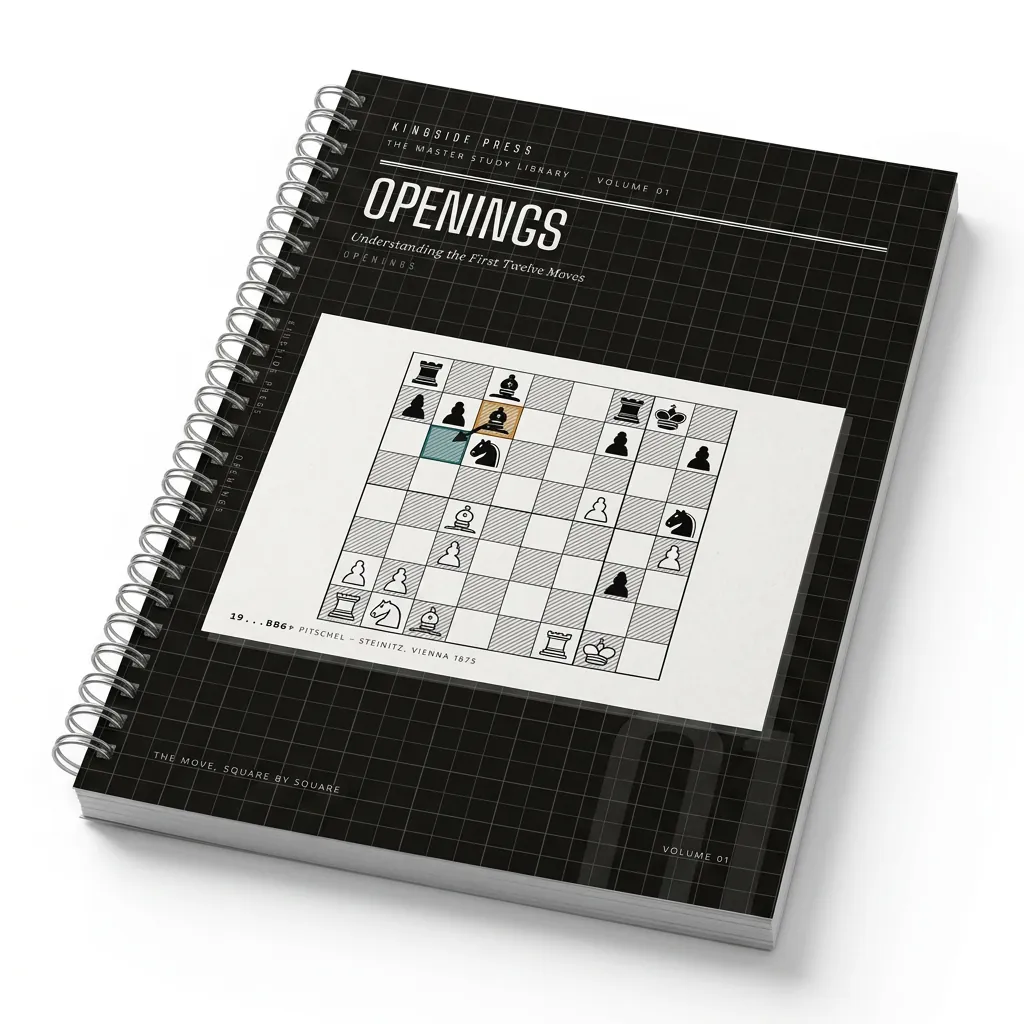
Almost every beginner learns openings the wrong way: they memorise a sequence of moves, the opponent deviates on move four, and the memory is worthless. The best chess openings for beginners are not the sharpest or the most fashionable — they are the ones whose plans you can understand and reuse, so that you still know what to do when the opponent plays something you have never seen.
This guide covers six openings that meet that test, plus the four principles that make any opening work. Every one of them is chosen because the resulting middlegame is natural to play: pieces come out, the king gets safe, and the plan is visible from the pawn structure.
1. The four principles that beat memorisation
Before any named opening, four rules decide the first twelve moves: develop a new piece with almost every move, fight for the centre, castle early, and do not move the same piece twice without a concrete reason. A player who follows these four rules will reach a playable middlegame against any opening in the world, including ones they have never studied.
The reason they work is tempo. Every move is a unit of time you can never buy back. When you grab a pawn on move eight and your opponent develops two pieces in return, you have exchanged something permanent (development) for something temporary (a pawn) — and the Romantic-era masters built entire careers on punishing exactly that trade.
Develop a new piece nearly every move for the first ten moves.
Control the centre — occupation with pawns, or pressure with pieces.
Castle before you start any attack, not after it stalls.
Do not chase pawns while your king is still in the middle.
2. The Italian Game — the best first opening for White
1.e4 e5 2.Nf3 Nc6 3.Bc4. Three moves, and White has developed two pieces, occupied the centre, attacked the f7 square and prepared to castle. Nothing is hidden and nothing needs memorising: the bishop eyes f7, the knight eyes d4 and e5, and the plan is to castle, play d3 and c3, then build a broad pawn centre with d4.
The Italian teaches the two lessons every beginner needs — the value of rapid development and the danger of the weak f7/f2 square. It also produces open positions where tactics actually appear, which is where beginners learn fastest. Avoid the fashionable Fried Liver rabbit hole at first; play the slow c3/d3 setup and learn to build a centre.
1.e4 e5 2.Nf3 Nc6 3.Bc4 — two pieces out, centre contested, castling next.
Plan: castle, d3, c3, then d4 to expand in the centre.
It teaches f7 weakness and open-position tactics — the fastest way to improve.
3. The Scotch Game — open the position immediately
1.e4 e5 2.Nf3 Nc6 3.d4. White strikes in the centre at once and the position opens on move three. This suits beginners because open positions punish and reward the principles you are learning: the player with better development usually wins, quickly and visibly.
The Scotch also sidesteps the enormous body of Ruy Lopez theory. After 3...exd4 4.Nxd4, White has a free hand, no memorised lines are required, and the middlegame plans — pressure on the e-file, the d5 outpost, quick castling — repeat game after game.
1.e4 e5 2.Nf3 Nc6 3.d4 opens the game before theory can matter.
Open positions make development advantages decisive — ideal for learning.
Recurring plans: e-file pressure, the d5 square, fast kingside castling.
4. The London System — one setup against almost everything
1.d4 followed by Bf4, e3, Nf3, c3, Bd3 and Nbd2. The London is a system rather than a line: you aim for the same structure whatever Black plays. For a beginner with limited study time, that is enormously valuable — you spend your energy on middlegame plans instead of move orders.
The trade-off is honest: the London gives White a small, slow edge rather than a sharp initiative. But the standard plans (the Bf4/Bd3 battery aiming at h7, the e5 square, the minority attack on the queenside) are clear, repeatable, and teach structure better than any memorised sharp line.
One setup — Bf4, e3, Nf3, c3, Bd3, Nbd2 — against nearly every Black reply.
Minimal theory; your study time goes to plans, not move orders.
Core ideas: the bishop battery on h7, the e5 outpost, the minority attack.
5. The Caro-Kann — the soundest answer to 1.e4 for Black
1.e4 c6, planning 2...d5. Black challenges the centre immediately and, unlike the French Defence, keeps the light-squared bishop outside the pawn chain — the single most common source of long-term suffering for beginners playing 1...e6.
The Caro-Kann is solid without being passive: Black gets a healthy structure, a good bishop, and typically an endgame-friendly position. If you lose games as Black because you get attacked before you finish developing, this is the opening that stops it.
1.e4 c6 followed by 2...d5 contests the centre on move two.
Bf5 or Bg4 develops the light-squared bishop before ...e6 locks it in.
Solid structures and good endgames — the antidote to being attacked early.
6. Queen's Gambit and the Sicilian — when you are ready for more
The Queen's Gambit (1.d4 d5 2.c4) is the classical way to fight for the centre and remains one of the best openings to grow into: it teaches pawn structure, the isolated queen's pawn, and the minority attack — three topics that carry directly into positional strategy.
The Sicilian (1.e4 c5) is the most successful reply to 1.e4 at every level, but it is theory-heavy and tactically sharp. It is a superb opening and a poor first one. Play it once your tactics are reliable; until then, the Caro-Kann or 1...e5 will teach you more per hour of study.
Queen's Gambit: the classical structure school — IQP, minority attack, centre.
Sicilian: strongest scoring reply to 1.e4, but theory-heavy — grow into it.
Choose openings by how much they teach you, not by their reputation.
7. The first moves on the board — three openings in diagrams
Reading opening moves in notation is slow; seeing them on a board is instant. The three positions below are the ones you will reach most often as a beginner, and each one already tells you the plan. Set them up on a real board, play the moves with your hands, and the structure will stay with you far longer than a memorised line ever could.
Notice what the three have in common: two or three pieces developed, a pawn in the centre, and castling available within one move. That is the whole opening phase of chess in one sentence, whether you are playing the Italian Game, the London System or the Caro-Kann Defence.
♜
♞
♝
♛
♚
♝
♞
♜
♟
♟
♟
♟
♟
♟
♟
♞
♟
♗
♙
♘
♙
♙
♙
♙
♙
♙
♙
♖
♘
♗
♕
♔
♖
1.e4 e5 2.Nf3 Nc6 3.Bc4 — Italian GameWhite's ideal beginner setup: knight and bishop out, a pawn on e4, castling next move, and pressure on the f7 square. The follow-up is 4.O-O, then c3 and d4 to build a broad centre.Black to move
♜
♞
♝
♛
♚
♝
♜
♟
♟
♟
♟
♟
♟
♟
♞
♟
♙
♗
♘
♙
♙
♙
♙
♙
♙
♙
♖
♘
♕
♔
♗
♖
1.d4 d5 2.Nf3 Nf6 3.Bf4 — London SystemA system, not a theory maze: the bishop escapes the pawn chain before e3 locks it in. White plays e3, Bd3, Nbd2, c3 and O-O against almost anything, then chooses between a kingside attack and the c4 break.Black to move
♜
♞
♝
♛
♚
♝
♞
♜
♟
♟
♟
♟
♟
♟
♟
♟
♙
♙
♙
♙
♙
♙
♙
♙
♖
♘
♗
♕
♔
♗
♘
♖
1.e4 c6 2.d4 d5 — Caro-Kann DefenceThe soundest beginner answer to 1.e4: Black challenges the centre immediately while keeping a healthy pawn structure and a clear path to develop the light-squared bishop, the piece that suffers most in the French Defence.White to move
Every good opening produces the same three things: development, a centre, and a safe king.
Play the moves on a physical board — the picture is what you will recall in a game.
Italian for White, London against 1...d5, Caro-Kann for Black covers most of your games.
8. Chess opening traps and how to punish them
Beginner games are full of cheap tricks, and the most common by far is Scholar's mate — the four-move mate aimed at f7 with the queen and bishop. It wins hundreds of online games a day against players who do not know the refutation, and it loses just as many for the player who tries it against someone who does.
The rule for meeting any early queen sortie is simple: develop with a move that also defends. Do not panic-push pawns in front of your king, and do not chase the queen with moves that lose time. Every tempo the enemy queen spends running is a tempo you spend developing — which is exactly the trade you want.
The same logic refutes the other classics: the Fried Liver Attack (answer 5...Na5 or the solid 4...d5 lines), the Englund Gambit, the Damiano Defence and the wing-pawn attacks that appear at every beginner level. Know the idea behind the trap and you never need to memorise the trap itself.
♜
♝
♛
♚
♝
♞
♜
♟
♟
♟
♟
♟
♟
♟
♞
♟
♕
♗
♙
♙
♙
♙
♙
♙
♙
♙
♖
♘
♗
♔
♘
♖
1.e4 e5 2.Bc4 Nc6 3.Qh5 — the Scholar's mate threatWhite threatens 4.Qxf7#. The mate only works because f7 is defended by the king alone — nothing about the position is actually strong for White.Black to move
♜
♝
♛
♚
♝
♜
♟
♟
♟
♟
♟
♟
♟
♞
♞
♟
♕
♗
♙
♙
♙
♙
♙
♙
♙
♙
♖
♘
♗
♔
♘
♖
3...Nf6! — the refutationThe knight develops, attacks the queen and covers h5-related tricks in one move. After the queen retreats, Black continues with d5 or Na5 and is already better: White has one piece developed and a displaced queen.White to move
Answer early queen raids with developing moves that also defend — 3...Nf6 is the model.
Never push pawns in front of your own king to shoo a piece away.
Traps rely on your ignorance of one idea; learn the idea, not the move order.
Chess terms used in this guide
Chess opening
The first ten to fifteen moves of a game, where the goals are development, central control and king safety rather than immediate material gain.
Development
Bringing knights, bishops, queen and rooks off their starting squares to active positions. A lead in development is the most common cause of a winning attack at club level.
Gambit
A voluntary pawn sacrifice for speed or initiative — the Queen's Gambit, King's Gambit and Evans Gambit are the classical examples.
Tempo
One unit of moving time. Attacking a piece that simply moves away 'gains a tempo'; chasing a piece with a bad move loses one.
Fianchetto
Placing a bishop on b2, g2, b7 or g7 behind a pawn on the third or sixth rank, aiming along the long diagonal. Central to the King's Indian and Réti setups.
Open, semi-open and closed games
Openings starting 1.e4 e5 (open), 1.e4 with any other black reply such as the Sicilian, French or Caro-Kann (semi-open), and 1.d4 d5 or flank openings (closed).
Transposition
Reaching the same position through a different move order — the reason understanding structures beats memorising lines.
Opening repertoire
The small set of openings you actually play: one as White, one against 1.e4 and one against 1.d4 is enough below 1800.
Isolated queen's pawn (IQP)
A d-pawn with no neighbouring pawns. It gives active pieces and open files but becomes a long-term weakness in the endgame.
Minority attack
Advancing fewer pawns against more on one wing, typically b4–b5 in the Queen's Gambit Exchange, to create a weak enemy pawn.
Prophylaxis
A move that prevents the opponent's plan before pursuing your own — the core of positional chess as taught by Nimzowitsch.
Book move
A move that is part of established opening theory. Being 'out of book' is normal by move eight in club chess and is not a problem if you know the plan.
Frequently asked questions
What is the best chess opening for a beginner?
The Italian Game (1.e4 e5 2.Nf3 Nc6 3.Bc4) for White and the Caro-Kann (1.e4 c6) or 1...e5 for Black. All three develop quickly, fight for the centre, and lead to positions whose plans you can understand without memorising theory.
How many openings should a beginner learn?
Two: one as White and one as Black against 1.e4, plus a simple setup against 1.d4. Depth beats breadth — repeatedly reaching the same structures is what teaches you the middlegame plans that actually win games.
Should beginners memorise opening lines?
No. Learn the first six to eight moves and, more importantly, the plan behind them. Below roughly 1800, games are decided by tactics and middlegame understanding, not by opening preparation.
Is the London System good for beginners?
Yes. It is a system rather than a set of lines, so you reach the same structure against almost anything Black plays. It gives a modest but reliable edge and lets you spend study time on plans instead of move orders.
Volume 1 · Openings
Understanding the First Twelve Moves
Development, control of the centre, tempo and king safety — and the real cost of grabbing material too early. You see how a small opening advantage turns into a winning middlegame.