Most players who ask how to get better at chess are already putting in the hours. They play daily, solve puzzles, watch videos — and their rating has not moved in a year. The problem is almost never effort; it is allocation. Time goes into the parts of chess that feel productive rather than the parts that decide games.
This guide sets out where the time should go, how to analyse your own games so the lessons actually stick, and what to prioritise at each rating band.
1. Where your study time should actually go
For anyone under 1800, a defensible split is roughly 40% tactics and calculation, 25% endgames, 20% middlegame strategy and annotated games, and 15% openings. Most improving players invert that and spend the majority of their time on openings — the part of the game that decides the fewest of their results.
The reason endgames deserve a quarter of your time is leverage: endgame knowledge is permanent. A rook-endgame technique learned once will win you games for the next thirty years, while an opening line can be obsolete or simply avoided by your opponent.
Openings are the least decisive part of your results at club level.
Endgame knowledge never expires — it is the highest-leverage study there is.
2. Analyse your own games — before turning on the engine
Take your loss, sit with it, and write down where you think the game turned and what you were thinking at that moment. Only then check with an engine. The engine tells you what was best; only you can tell you why you did not consider it, and that second answer is the one that changes your future games.
Keep a short error log. After twenty games you will find your mistakes are not random — they cluster into three or four repeating types: rushing in quiet positions, missing opponent's checks, trading into bad endgames. That list is your personal study plan.
Analyse without the engine first; record what you were actually thinking.
Keep an error log — your mistakes repeat in three or four clusters.
Study the clusters, not a generic curriculum.
3. Play slower games than feels comfortable
Blitz and bullet are the least efficient forms of practice for an improving player. They reinforce the habits you already have because there is no time to build new ones. Long games — 15+10 at minimum, ideally 30 minutes or more — are where you can actually apply what you studied.
One slow game with a real analysis afterwards is worth more than twenty blitz games. Two or three per week is enough for steady improvement, provided each one gets reviewed.
Play 15+10 or slower; blitz reinforces existing habits rather than new ones.
Two or three analysed slow games a week beats twenty unreviewed blitz games.
Use the extra time deliberately: check opponent threats every move.
4. Work through annotated master games
Playing through well-annotated classical games is the oldest training method in chess and still one of the best. It transfers plans and structures wholesale: you absorb what a good position looks like, what a weakness is worth, and what an attacker does with an open file.
Do it actively. Cover the moves, guess the next one, then compare. Guess-the-move on twenty annotated games teaches more than passively watching two hundred.
Play through annotated games with the moves covered — guess, then compare.
Classical games teach structure and plans faster than modern engine games.
Twenty games studied actively beats two hundred watched passively.
5. What to prioritise at each rating band
Under 1000: stop hanging pieces. Nothing else matters. Check every move for opponent captures and checks, and learn basic mates (queen and king, rook and king).
1000–1400: tactics patterns and basic endgames. Learn the square of the pawn, opposition, and the eight tactical motifs. Openings only to the extent of following the four principles.
1400–1800: positional understanding — pawn structure, outposts, good and bad bishops, prophylaxis — plus rook endings, which decide more games at this level than anything else.
1800+: deeper calculation, opening preparation aimed at reaching structures you understand, and serious endgame technique.
Under 1000: stop hanging pieces and learn the basic mates.
1000–1400: tactical motifs plus king-and-pawn endgames.
1400–1800: pawn structure, prophylaxis and rook endings.
1800+: calculation depth and structure-driven opening prep.
6. Consistency beats intensity
Thirty focused minutes a day will take you further than a five-hour weekend session, because pattern recognition is built by repeated exposure, not by volume in one sitting. The players who improve fastest are usually the ones with the least dramatic schedule.
Make the material physical if you can. A printed workbook next to a real board removes every notification and every temptation to click for the answer — which is exactly why we designed our volumes to print cleanly and keep solutions on a later page.
Thirty focused minutes daily beats one long weekend session.
Work at a real board where possible — visualisation improves faster.
Keep solutions out of sight so you are forced to calculate.
7. The endgame knowledge that wins the most games
Endgames are where club players throw away the most half-points, and where study pays the highest interest rate, because endgame technique never goes out of date. Four things cover the majority of practical cases: opposition in king-and-pawn endings, the square of the pawn, the Lucena and Philidor positions in rook endings, and the rule that rooks belong behind passed pawns.
The two diagrams below are the arithmetic of the endgame. Neither takes ten minutes to learn, and between them they decide thousands of games a day online — usually in favour of whichever player bothered to learn them.
♚
♔
♙
Opposition with a pawnWhite to move only draws; Black to move loses. Whoever is forced to move first must give ground, which is why the whole discipline of king-and-pawn endings is about who steps first — not who is faster.
♙
♚
♔
The square of the pawnDraw an imaginary square from the pawn to its promotion rank. If the defending king can step inside that square on its move, it catches the pawn; if it cannot, the pawn promotes and you need not calculate a single move.Black to move
Learn opposition, the square of the pawn, Lucena and Philidor — in that order.
Rooks belong behind passed pawns, yours and your opponent's.
Endgame knowledge compounds: learned once, it wins games for decades.
8. Build an error log from your own games
Analysing your games without a system produces a pile of engine evaluations and no learning. A log turns them into a curriculum. For each loss, write one line: the move number, what you played, what you should have played, and the single-word category — tactic missed, blunder, wrong plan, time trouble, opening confusion, endgame technique.
After twenty games, count the categories. Whatever tops the list is your study plan for the next month, and it is almost never the thing you assumed. Most players discover that opening preparation ranks near the bottom, while missed tactics and endgame technique dominate — exactly the reverse of how their study time is spent.
Analyse the game yourself before switching the engine on. The engine tells you the truth about the position; only your own analysis tells you the truth about your thinking, and it is your thinking you are trying to change.
One line per loss: move number, played, better move, error category.
Count categories every twenty games — that ranking is your study plan.
Always analyse unassisted first; the engine goes on afterwards.
Chess terms used in this guide
Elo rating
The number that estimates your strength from results. A 100-point gain means you now score about 64% against your former peers.
Blunder, mistake, inaccuracy
Engine labels for errors of roughly 2.0, 1.0 and 0.5 pawns. Counting blunders per game is the fastest progress metric there is.
Calculation
Working out concrete move sequences. Trained by solving puzzles fully in your head, without moving pieces.
Visualisation
Seeing the position after several moves without moving them. The skill that limits calculation depth for most club players.
Pawn structure
The skeleton of the position. It dictates which files and squares matter and therefore what the correct plan is.
Outpost
A square, usually on the fifth or sixth rank, that no enemy pawn can attack — ideal for a knight.
Good and bad bishop
A bishop is 'bad' when its own pawns sit on its colour squares, blocking its diagonals.
Space advantage
Controlling more squares, which gives your pieces more routes and cramps your opponent's.
Initiative
Being the side making threats. Worth material in sharp positions and nothing at all in blocked ones.
Time control
Bullet, blitz, rapid and classical. Learning happens at rapid and slower, where you have time to apply new ideas.
Opening principles
Develop, control the centre, castle early, do not move the same piece twice. They replace theory below 1800.
Annotated game
A master game with written explanations of each plan. The highest-value study material per hour after tactics.
Deliberate practice
Working at the edge of your ability with feedback. Playing more blitz is practice; solving hard puzzles and reviewing them is deliberate practice.
Frequently asked questions
How long does it take to get better at chess?
With 30 focused minutes a day and two analysed slow games a week, most players under 1400 see meaningful rating gains within two to three months. Progress above 1800 is slower and depends more on calculation depth and endgame technique.
What is the fastest way to improve at chess?
Tactics training plus analysing your own losses without an engine first. Those two habits address the mistakes that actually cost you games, which generic study rarely does.
Does playing blitz help you improve?
Not much on its own. Blitz reinforces existing habits because there is no time to apply new ideas. Use slower time controls for learning and blitz sparingly for opening familiarity.
Do I need a chess coach to improve?
No, though a coach speeds things up. A structured curriculum, an error log from your own games, and consistent daily practice cover most of what a coach provides at club level.
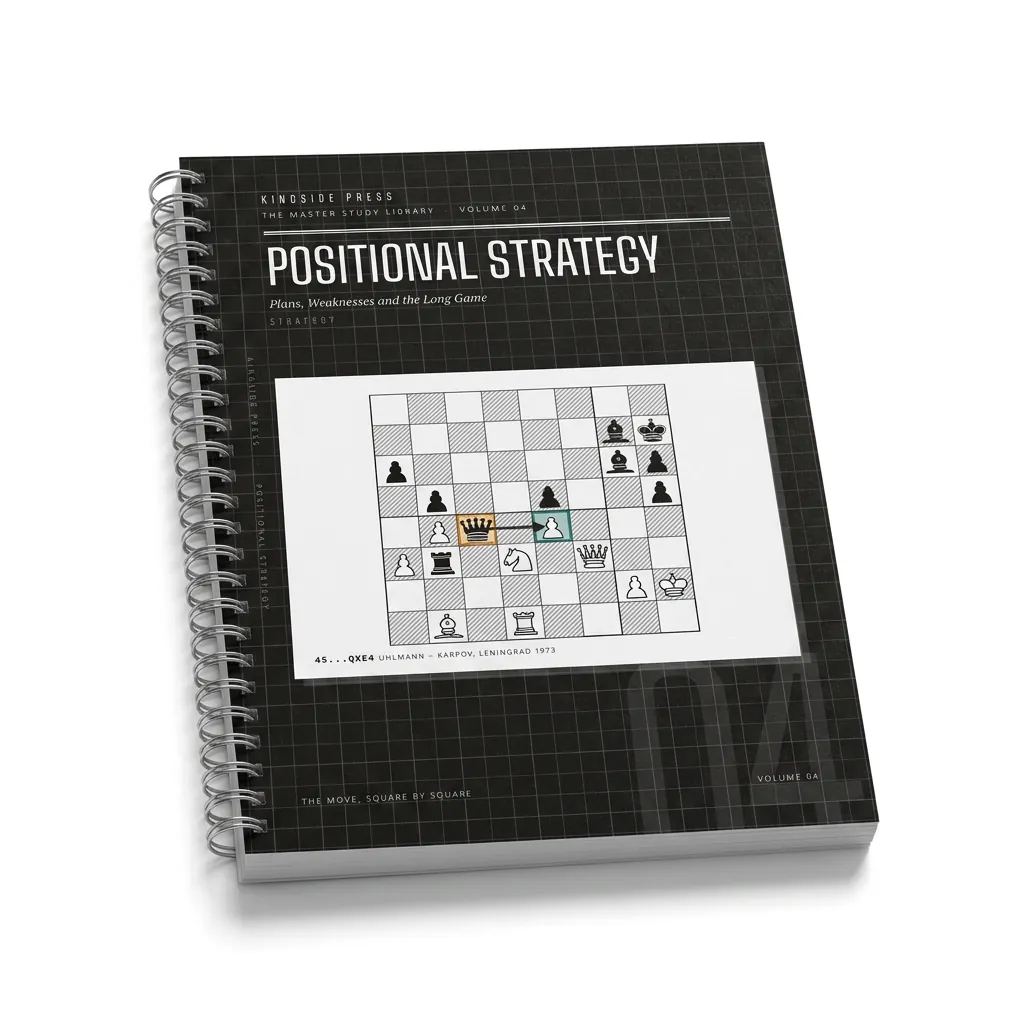
Volume 4 · Positional Strategy
Plans, Weaknesses and the Long Game
Structural thinking: pawn weaknesses, outposts, good and bad bishops, piece quality, space, restraint, and the accumulation of small advantages until one of them decides the game.