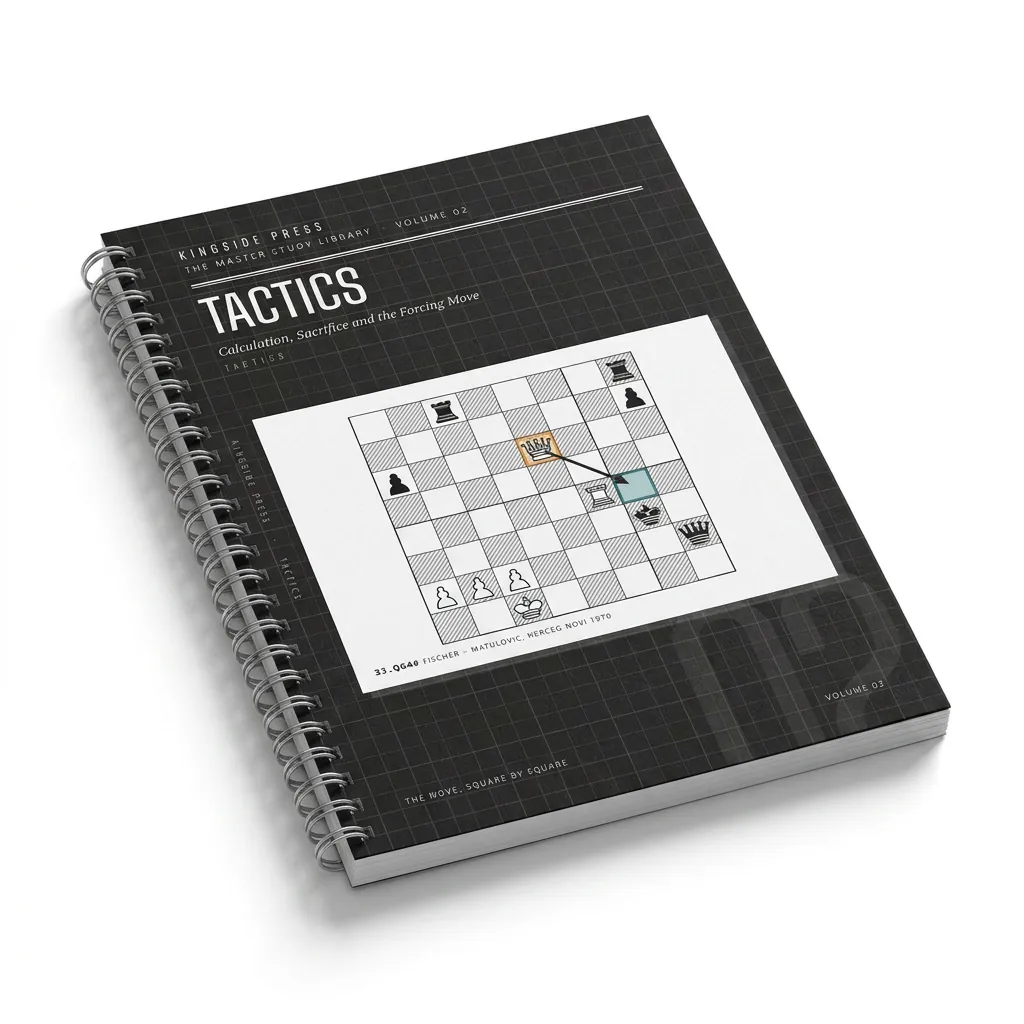
Chess Tactics — The Eight Patterns That Decide Games
4.8 · 412 reviews
Tactics decide almost every game played below 1800. Not strategy, not opening preparation — a piece hangs, a fork appears, a back rank collapses. The good news is that tactics are finite: a small number of geometric patterns generate the overwhelming majority of them, and once you can name a pattern you start seeing it in your own games.
This guide covers the eight patterns worth knowing cold, and then the part most beginners skip: a repeatable calculation method that turns pattern recognition into points on the scoreboard.
1. The fork (double attack)
One piece attacks two targets at once. The knight fork is the most famous because a knight's movement is the hardest to visualise, but queens, pawns and even kings fork constantly. The family resemblance is what matters: any move that creates two threats wins material, because your opponent can only answer one.
Train the pattern by looking for undefended pieces and the king on the same colour complex. Two loose pieces on squares a knight can reach in one move is not a coincidence — it is a fork waiting to happen.
Any move creating two threats at once usually wins material.
Scan for loose pieces and the king on squares a single knight jump connects.
Pawn forks are the most commonly missed of all.
2. Pins and skewers
A pin freezes a piece because moving it would expose something more valuable behind it. An absolute pin (against the king) makes the pinned piece literally immobile; a relative pin makes moving it expensive. A skewer is the same geometry reversed: the valuable piece is in front, and when it moves the piece behind it falls.
The practical skill is not spotting the pin — it is exploiting it. A pinned piece is a defender that no longer defends. Pile more attackers onto it, or attack the square it is standing on with a pawn.
A pinned piece stops being a defender — attack what it was protecting.
Add attackers to a pinned piece, or hit it with a pawn.
Skewers are pins in reverse: the big piece is in front.
3. Discovered attacks and discovered check
Move one piece and a second piece behind it delivers the attack. The moving piece is free to do anything at all — including capturing something defended — because the opponent must answer the discovered threat first. Discovered check is the most violent version: the opponent has no choice whatsoever.
Look for these whenever your own pieces stand on the same line as an enemy king or queen. Your 'blocking' piece is not in the way; it is a loaded gun.
Your own piece standing in front of a rook or bishop is an opportunity, not a blockage.
The moving piece can capture or attack anything — the discovery covers it.
Discovered check is close to unanswerable; hunt for it in every sharp position.
4. Deflection, decoy and removing the defender
Three ways of dismantling a defence. Deflection drags a defender away from the square it guards. Decoy lures a piece — usually the king — onto a square where it can be attacked. Removing the defender simply captures or chases the piece holding everything together.
This family is where sacrifices come from. A queen sacrifice that deflects the one rook guarding the back rank is not a leap of faith; it is arithmetic. Count defenders before you count material.
Identify the single piece holding the defence together, then remove or deflect it.
Decoys drag the king to a square where a check becomes decisive.
Most 'brilliant' sacrifices are just deflection with the maths done correctly.
5. Overloading and the back rank
An overloaded piece is doing two jobs at once — guarding a mating square and a hanging piece, for example. Attack one job and the other collapses. Back-rank weakness is the most common overload of all: the rook that must stay home to prevent mate cannot also defend the queenside.
Before every move in a sharp position, check your own back rank. More club games are lost to a back-rank mate the loser 'saw' one move too late than to any opening mistake.
A defender with two jobs has zero jobs — attack one of them.
Check your own back rank every single move in an open position.
Making luft (h3/h6) at a quiet moment is cheap insurance.
6. A calculation method that actually works
Pattern recognition finds the candidate; calculation confirms it. Use a fixed routine: list every forcing move first — checks, captures, threats — then calculate each to a quiet position, then evaluate. Most blunders happen because a player calculated the pretty line and never listed the opponent's checks.
Two discipline rules matter more than depth. First, always ask what your opponent's reply threatens, not just whether it stops your idea. Second, stop calculating when the position is quiet and evaluate honestly — an extra pawn in a lost structure is not an advantage.
List forcing moves first: checks, captures, threats — in that order.
Calculate each candidate to a quiet position before evaluating it.
After every candidate, ask what the opponent's best reply threatens next.
7. Chess puzzles in diagrams — see the pattern, then find it
Naming a tactic is not the same as seeing it. These positions are stripped to the bare geometry so the shape burns in: the knight fork, the pin and the back-rank collapse. Cover the caption, decide on White's move, then read the answer — that is how a chess puzzle should be solved, in your head and to the end.
Once the bare shapes are familiar, look for them in cluttered positions. A knight fork in a six-piece diagram is easy; the same fork in a real middlegame with thirty pieces is a rating point. That transfer only happens if you practise both.
♜
♚
♘
♔
The knight fork (double attack)One knight, two targets: the king on e8 and the rook on a8. The king must move and the rook falls. Train your eye to spot two loose enemy pieces a single knight jump apart — that is a fork waiting to be played.Black to move
♛
♚
♞
♗
♔
The pinThe f6 knight cannot legally leave the diagonal without losing the queen behind it. Pins do not win material by themselves — they freeze a defender so you can attack it again, here with e5, g5 or a second piece.White to move
♜
♚
♟
♟
♟
♙
♙
♙
♖
♔
Back-rank geometryBoth kings are boxed in by their own pawns and both rooks guard the entry square. Whoever wins the fight for the d-file, or deflects the defending rook, mates on the eighth or first rank. This is the single most decided-by pattern in club chess.White to move
Solve from the diagram in your head — moving pieces first destroys the training effect.
Learn the bare geometry, then hunt for it in real, cluttered middlegames.
A pin freezes a defender; you still need a second attacker to collect the material.
8. How to stop blundering — the pre-move checklist
Blunders are rarely calculation failures. The move was simply never considered. A fixed pre-move routine fixes more rating points than any amount of extra puzzle volume, because it removes the single largest source of lost games at every level below master.
The checklist has four questions, always in the same order. What does my opponent's last move threaten? What are all the checks, captures and threats available to me? Is every one of my pieces defended, and does my candidate move leave any of them loose? And finally: after my move, what is my opponent's most forcing reply?
Practise the routine in slow games only. In blitz there is no time to apply it, which is why blitz teaches almost nothing new — it merely rehearses the habits, good or bad, you already have.
Always answer 'what does their last move threaten?' before choosing your own.
List every check, capture and threat — for both sides — before committing.
Count loose pieces: undefended pieces are what forks and discovered attacks feed on.
Build the habit in long games; blitz only rehearses habits you already have.
Chess terms used in this guide
Fork (double attack)
One piece attacking two targets at once. Knight forks are the most missed; pawn forks the most common.
Pin
A piece cannot move without exposing a more valuable one behind it. An absolute pin is against the king and is illegal to break.
Skewer
The reverse of a pin: the valuable piece stands in front and must move, losing the piece behind it.
Discovered attack
Moving one piece to unleash the attack of another behind it. A discovered check is the most violent version.
Deflection
Forcing a defender away from the square or line it is guarding, usually with a check or a capture it must accept.
Decoy
Luring a piece — often the king — onto a square where a fork, pin or mate becomes available.
Removing the defender
Capturing or driving off the piece that holds a key square together, then taking what it defended.
Overloaded piece
A piece with two defensive duties. Attack one duty and the other collapses.
Zwischenzug (in-between move)
Inserting a more forcing move before making the 'expected' recapture, changing the evaluation of the whole line.
Windmill
A repeating sequence of discovered checks that harvests material each cycle — Torre–Lasker 1925 is the classic example.
Zugzwang
A position where any legal move worsens your position. Decisive in endgames and in some smothered-mate nets.
Desperado
A doomed piece that sells itself as expensively as possible before it is captured.
Candidate move
A move worth calculating. Strong players generate two or three candidates before calculating any of them deeply.
Forcing move
A check, capture or direct threat. Calculate these first — they narrow the opponent's replies and shorten the tree.
Frequently asked questions
What are the most important chess tactics?
Forks, pins, skewers, discovered attacks, deflection, decoy, removing the defender and overloading. Together they account for the large majority of material-winning moves in club games.
How do I stop blundering in chess?
Before every move, list your opponent's checks, captures and threats. Most blunders are not calculation failures but omissions — the move was never considered at all.
How many tactics puzzles should I do a day?
Fifteen to thirty focused puzzles beats hundreds of rapid guesses. Solve fully in your head before moving, and review every failure to name the pattern you missed.
Are tactics more important than strategy for beginners?
Yes, at first. You cannot execute a strategic plan while dropping pieces. Once tactics are reliable, positional understanding becomes the thing separating players who plateau from those who keep climbing.
Volume 2 · Tactics
Calculation, Sacrifice and the Forcing Move
Seeing forced continuations and trusting them. Double attack, pin, deflection, clearance and quality sacrifices — plus the discipline of calculating a line to the end instead of stopping at the pretty move.