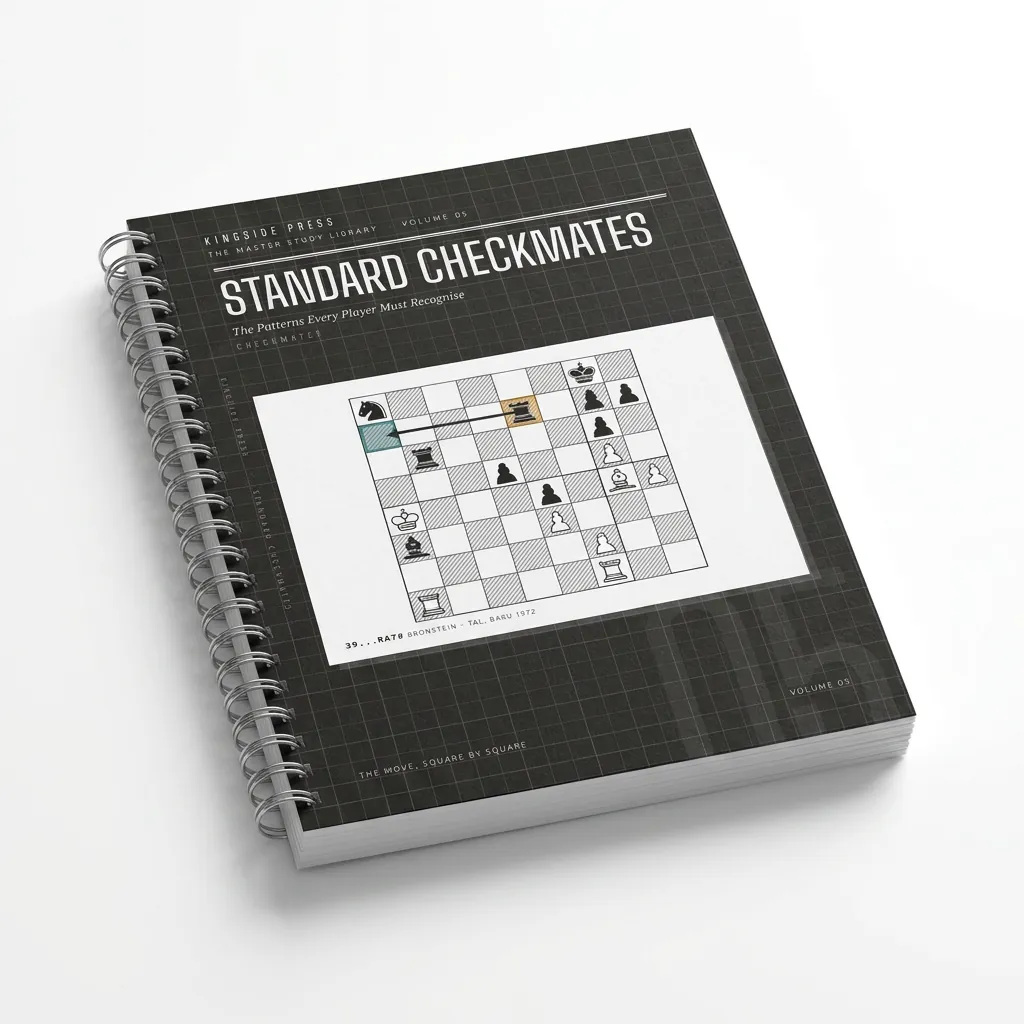
Attacks fail for one reason more than any other: the attacker cannot see the finish. You sense the king is weak, you throw pieces at it, and the attack fizzles because you never had a concrete mating picture in mind. Learning checkmate patterns fixes that — you stop attacking hopefully and start attacking towards a specific, known net.
Each pattern below is a fixed geometry. Learn the picture and you will recognise it two or three moves before it appears on the board, which is exactly when it is still possible to force it.
1. Back-rank mate and the ladder
A king trapped behind its own unmoved pawns, and a rook or queen arriving on the eighth rank. It is the most common mate in club chess in both directions — beginners deliver it constantly and walk into it just as often.
The ladder (two rooks, or rook and queen, alternating ranks) is the same idea generalised: one piece checks, the other covers the escape rank, and the king is walked to the edge. Master the ladder and every rook endgame becomes less frightening.
Rook or queen to the eighth rank against a king boxed in by its own pawns.
Overload check: is that defending rook also doing another job?
The ladder walks a king to the edge with two heavy pieces on adjacent ranks.
2. Smothered mate (Philidor's legacy)
A knight delivers mate to a king boxed in entirely by its own pieces. The classical sequence is a small miracle of forcing play: queen check in the corner, king to the corner, knight check, king back, and then a queen sacrifice that forces the rook onto the escape square, followed by the knight's final jump.
You will not get it often, but the pattern trains something more useful than its own frequency: the ability to see the opponent's pieces as the cage, not the defence.
Knight mate against a king suffocated by its own pieces.
The queen sacrifice exists to force a defender onto the escape square.
Watch for it whenever the enemy king is castled and the g-file is blocked.
3. Anastasia's mate and the Arabian mate
Anastasia's mate: a knight on e7 (or the mirror square) takes away g8 and g6, and a rook arrives on the h-file. Boxed in by its own g-pawn, the king has nowhere to go. It appears constantly in games with an open h-file — which is to say, in every game where you sacrifice on h7.
The Arabian mate is rook and knight cooperating in a corner: the knight covers the flight squares, the rook delivers the check along the rank or file with the knight protecting it. Both patterns are worth knowing because rook-and-knight is the coordination beginners handle worst.
Anastasia: knight on e7 plus rook on the h-file against a castled king.
Arabian: knight guards the escape squares while the rook checks, protected.
Both convert an open h-file or a corner king into a forced finish.
4. Boden's mate and the two-bishop finishes
Boden's mate is two bishops on crossing diagonals meeting at a king that has castled queenside, usually after a sacrifice clears the c-file or the a6–f1 diagonal. The double-bishop mate (both bishops raking a kingside castled position after the h-pawn falls) is its mirror image.
The lesson underneath both is bishop-pair power in an open position. If your opponent's king has lost its pawn cover and you own two bishops, the mating net is usually already there.
Two bishops on crossing diagonals mate a queenside-castled king.
Clearance sacrifices exist to open the diagonal, not to win material.
Bishop pair plus stripped pawn cover equals a mating net worth hunting.
5. The h-file battery and the rook lift
The most reusable attacking mechanism in chess: open the h-file, stack queen and rook on it, and mate on h7 or h8. The rook lift (Rf1–f3–h3) is how the second attacker arrives when the file is not yet open, and it is the move most beginners never consider.
The order matters. Bring the rook first, then open the file — reversing it lets the defender contest the file before your battery is loaded.
Load the battery before opening the file, not after.
The rook lift (Rf3–h3) is the standard way to add a second attacker.
Aim at h7/h8 whenever the enemy king is castled short and the g-pawn is fixed.
6. How to train mating patterns
Train patterns as pictures, not as move sequences. Set up the final position, look at it, then set up the position two moves earlier and force your way to it. This builds recognition from the mate backwards, which is how strong players actually see them.
Then find the same pattern inside real games. A pattern learned in isolation is a party trick; a pattern recognised in a messy middlegame is rating points.
Learn each mate as a final picture first, then work backwards.
Immediately find the same pattern inside an annotated real game.
Test yourself with exercises where the solution is on a later page.
7. Basic checkmates in diagrams — queen, rook and two bishops
Before the beautiful nets come the mandatory ones. If you cannot mate with king and queen, or king and rook, against a lone king, you will draw won games — and nothing costs more rating points than that. Both techniques are the same idea: shrink the box, keep the kings facing each other, deliver the check on the edge.
The two-bishop mate follows the same principle with a wider net, and king plus bishop plus knight is the one most players can safely ignore until 1800. Learn the first two to the point where they are automatic, in under twenty moves, every time.
♚
♕
♔
Queen and king mateThe queen delivers the check on the edge while the king removes every escape square. The whole method: walk the enemy king to any edge with the queen a knight's move away, then bring your own king up before the final check.
♖
♚
♔
Rook and king mateMate happens only when the kings stand directly opposite each other and the rook checks along the rank. That head-to-head position is the whole technique — the rook simply cuts the board in half until the box closes.
♚
♔
Opposition — the position to aim forNot a mate, but the shape that decides king-and-pawn endgames: whoever must move loses ground. Understanding opposition converts more endgames than any mating pattern.
King and queen, and king and rook, must be automatic — practise until under twenty moves.
Every basic mate needs your own king; heavy pieces alone cannot cover the escape squares.
Opposition is the endgame counterpart of a mating pattern — learn the picture.
8. Fool's mate, Scholar's mate and other quick mates
The fastest possible checkmate in chess is Fool's mate, delivered by Black on move two after 1.f3 e5 2.g4 Qh4#. It never happens between competent players, but it teaches the sharpest lesson in the game: the pawns in front of your king are its roof, and every one you move opens a hole you cannot close again.
Scholar's mate (four moves, queen and bishop against f7), the Légal Trap and the various g4/h5 attacks all exploit the same thing. And the same defensive rule answers all of them: develop with moves that defend, castle early, and never weaken f7/f2 or the g-file without a concrete reason.
♜
♞
♝
♚
♝
♞
♜
♟
♟
♟
♟
♟
♟
♟
♟
♙
♛
♙
♙
♙
♙
♙
♙
♙
♖
♘
♗
♕
♔
♗
♘
♖
1.f3 e5 2.g4 Qh4# — Fool's mateWhite's two pawn moves opened the e1–h4 diagonal and removed every defender of h4. Checkmate in two, and a permanent reminder that f- and g-pawn moves near your own king are the most expensive moves in chess.
The fastest mate is two moves — and it is caused purely by weakening pawn moves.
The f7 and f2 squares are the weakest points in the starting position.
Castling early defuses nearly every quick-mate attempt you will meet online.
Chess terms used in this guide
Back-rank mate
Mate delivered by a rook or queen on the eighth (or first) rank against a king trapped by its own unmoved pawns.
Ladder mate
Two heavy pieces alternating ranks or files to walk the enemy king to the edge.
Smothered mate
A knight mate against a king completely boxed in by its own pieces, usually set up with a queen sacrifice.
Anastasia's mate
Knight on e7 plus a rook on the h-file against a king on g8 or h7.
Arabian mate
Rook and knight combining in a corner: the knight guards the rook and covers the escape square.
Boden's mate
Two bishops on crossing diagonals against a castled king, typically after a sacrifice opens the b- or c-file.
Scholar's mate
The four-move mate on f7 with queen and bishop. Refuted by any developing move that defends, such as Nf6 or g6.
Fool's mate
The fastest mate in chess: 1.f3 e5 2.g4 Qh4#.
Mating net
A cluster of pieces covering every escape square, so mate becomes unavoidable even without an immediate check.
Battery
Two pieces stacked on the same file, rank or diagonal — queen behind rook on the h-file is the standard attacking battery.
Rook lift
Moving a rook up and across (Rf1–f3–h3) to join a kingside attack before the file is open.
Stalemate
No legal move and no check — a draw. The most common way a winning endgame is thrown away.
Perpetual check
A drawing resource where one side checks forever; the defensive twin of a mating net.
Frequently asked questions
What are the most common checkmate patterns?
Back-rank mate, the ladder mate, smothered mate, Anastasia's mate, the Arabian mate, Boden's mate and the h-file battery mate. These cover the large majority of forced finishes in practical play.
What is the fastest checkmate in chess?
Fool's mate, in two moves (1.f3 e5 2.g4 Qh4#). It only occurs through catastrophic play, but it illustrates the principle that weakening the squares around your king is the real danger.
How do I learn checkmate patterns quickly?
Study each pattern as a final position, reconstruct it from two moves earlier, then find it in an annotated master game. Recognition of the picture is what transfers to your own games — memorised move orders do not.
Why do my attacks never end in checkmate?
Usually because there was no target picture. Attacks succeed when you play towards a specific mating net; without one, pieces arrive at the kingside with no coordinated finish and the attack burns out.
Volume 5 · Standard Checkmates
The Patterns Every Player Must Recognise
The recurring mating nets — back rank, Philidor's smothered mate, Arabian, Anastasia, Boden, the ladder, the h-file battery — shown first as pure pattern, then inside a real game, then as an exercise.