The four-move win is Scholar's Mate: a queen and bishop team up on f7, the weakest square in Black's camp, and deliver checkmate before either side has castled. It works constantly against unprepared opponents and never again afterwards.
This guide shows the moves, the refutation you can play the very next time someone tries it on you, and the reason strong players abandon it — plus the mating pattern hiding underneath it, which does keep working for the rest of your chess life.
1. Scholar's Mate — the four moves
1.e4 e5 2.Bc4 Nc6 3.Qh5 Nf6?? 4.Qxf7#. The bishop on c4 and the queen on h5 both attack f7. That square is defended only by the black king, so when the queen lands on it supported by the bishop, it is checkmate: the king cannot take a defended queen and has no escape square.
A calmer move order is 3.Qf3 instead of 3.Qh5, which threatens the same mate on f7 without immediately hanging the queen to ...Nf6 or ...g6. Both rely on the same target.
♜
♝
♛
♚
♝
♞
♜
♟
♟
♟
♟
♟
♟
♟
♞
♟
♕
♗
♙
♙
♙
♙
♙
♙
♙
♙
♖
♘
♗
♔
♘
♖
3.Qh5The queen and the c4 bishop both hit f7. Black must deal with the threat of 4.Qxf7# right now.Black to move
♜
♝
♛
♚
♝
♜
♟
♟
♟
♟
♕
♟
♟
♞
♞
♟
♗
♙
♙
♙
♙
♙
♙
♙
♙
♖
♘
♗
♔
♘
♖
4.Qxf7#Checkmate. The queen is defended by the bishop on c4, the king cannot capture, and every escape square is covered by its own pieces.Black to move
1.e4 e5 2.Bc4 Nc6 3.Qh5 Nf6?? 4.Qxf7#.
f7 and f2 are defended only by the king at the start of the game.
The mate needs two attackers: the queen delivers, the bishop defends her.
2. The refutation: how to stop it every time
After 3.Qh5, play 3...g6. The pawn attacks the queen and blocks the h5-f7 diagonal in one move. If White then plays 4.Qf3, defend f7 again with 4...Nf6, and White's queen is already misplaced — you will chase it around with ...Nd4 or ...Nd5 and gain free development with every attack.
Against 3.Qf3, the simplest defence is 3...Nf6, which covers nothing on f7 — so prefer 3...Qe7 or 3...Nh6 followed by ...Nc6 and quick castling. The universal principle beneath all of this: meet an early queen sortie by developing pieces that attack her.
One warning: after 3.Qh5 g6 4.Qxe5+ White forks the king and the h8 rook if Black has played carelessly, so develop with 3...g6 only when your knight is on c6 covering e5 — as it is in the main line above.
3...g6 hits the queen and shuts the diagonal at the same time.
Keep the knight on c6 so ...g6 never drops the e5 pawn with check.
Answer an early queen with developing moves that attack her — you gain tempo.
3. Fool's Mate — the two-move loss
The fastest possible checkmate is against you, not by you: 1.f3 e5 2.g4?? Qh4#. By pushing the f- and g-pawns White opens the e1-h4 diagonal straight to the king, and the queen simply arrives.
It almost never happens in real games, but the lesson is exact and permanent: pawns in front of your king never come back. Every f3, g4, h3 or h6 push weakens squares that stay weak for the rest of the game.
1.f3 e5 2.g4 Qh4# — the two-move mate.
Pushing f- and g-pawns early opens diagonals at your own king.
Pawn moves are permanent; piece moves can be undone.
4. Why early queen attacks stop working
Above roughly 800 rating, every opponent knows the f7 trick. When it fails, the attacker is left with a developed queen and nothing else: each defensive move Black makes also attacks her, so Black develops for free while White retreats. Three or four tempi is a decisive head start in an open position.
The habit to build instead is the one behind the trick: identify the weakest defended square in the enemy camp and bring a second attacker to it. That is the engine of every real attack in chess, and unlike Scholar's Mate, it never stops working.
A failed early queen raid gives your opponent free development.
Attack with pieces you have already developed, not with the queen alone.
The transferable idea: two attackers on the weakest defended square.
5. The mating patterns that actually win games
Scholar's Mate is one instance of a family: the back-rank mate, the smothered mate, Anastasia's mate, Boden's mate, the Greek gift sacrifice on h7 and the queen-and-rook ladder. Each is a fixed geometric picture that, once memorised, you spot instantly in your own games.
That is exactly what Volume 5 of The Master Study Library drills: every standard checkmate pattern, shown from real games with one diagram per move and exercises whose solutions sit on a later page, so you test yourself before you check.
Learn back-rank, smothered, Anastasia's, Boden's and the Greek gift.
Patterns are recognition, not calculation — that is why drilling them works.
Spot the pattern first, then calculate to confirm it.
Chess terms used in this guide
Scholar's Mate
The four-move checkmate on f7 using the queen and light-squared bishop.
Fool's Mate
The two-move checkmate, 1.f3 e5 2.g4 Qh4#, caused by opening the e1-h4 diagonal.
Tempo
A unit of time in chess. Forcing an opponent's piece to move twice while you develop gains a tempo.
Back-rank mate
Checkmate delivered by a rook or queen on the eighth rank when the king is trapped behind its own pawns.
Frequently asked questions
How do you win chess in 4 moves?
Scholar's Mate: 1.e4 e5 2.Bc4 Nc6 3.Qh5 Nf6 4.Qxf7#. The queen captures on f7 defended by the bishop on c4, and the black king has no legal reply.
How do you defend against the 4-move checkmate?
After 3.Qh5, play 3...g6 — it attacks the queen and blocks the diagonal to f7. Keep the knight on c6 so the e5 pawn is defended, then develop and chase the queen.
What is the fastest checkmate in chess?
Fool's Mate, in two moves: 1.f3 e5 2.g4 Qh4#. It only occurs when White wrecks the pawns in front of the king.
Is Scholar's Mate a bad opening?
As a strategy, yes. Against anyone who knows the defence, the early queen is chased around and you fall several moves behind in development.
Why is f7 the weakest square in chess?
At the start of the game f7 (and f2 for White) is defended only by the king, so a single extra attacker there can be decisive before castling.
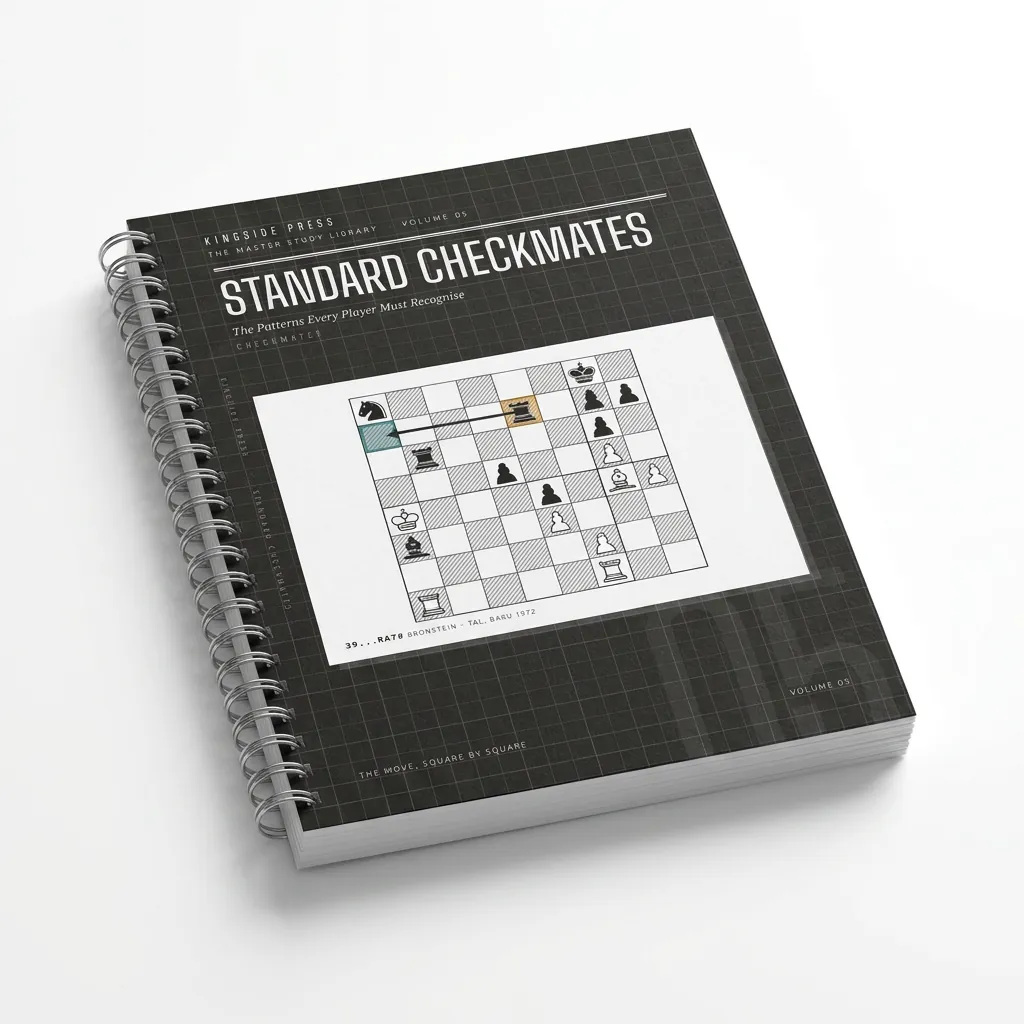
Volume 5 · Standard Checkmates
The Patterns Every Player Must Recognise
The recurring mating nets — back rank, Philidor's smothered mate, Arabian, Anastasia, Boden, the ladder, the h-file battery — shown first as pure pattern, then inside a real game, then as an exercise.